
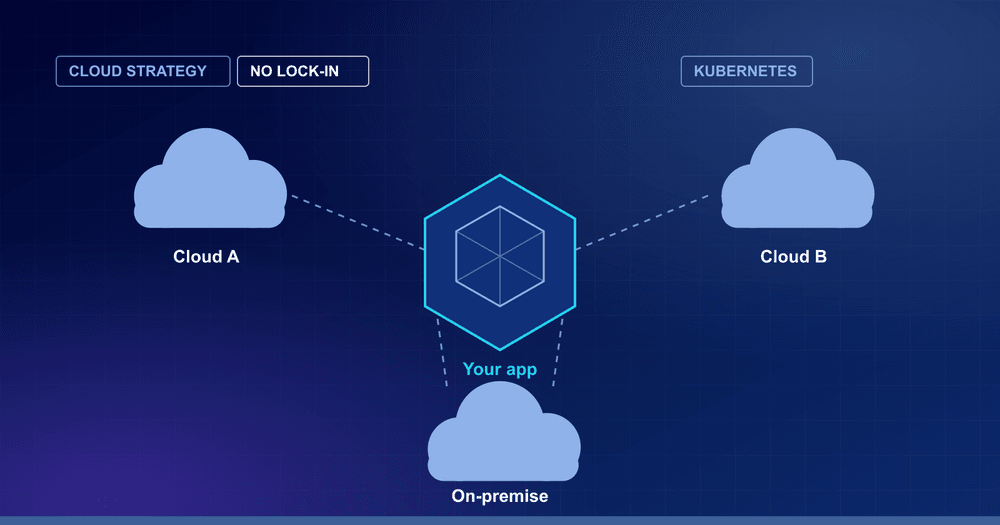
In today’s digital economy, businesses are deploying applications across AWS, Azure, GCP, and private clouds. While choosing a single vendor seems convenient initially, it often leads to “lock-in”—making future migrations expensive and complex. Cloud-agnostic development ensures your applications can run on any cloud provider with minimal rework, maximizing flexibility, scalability, and cost control.
Here are the key benefits of adopting a cloud-agnostic strategy:
1) Freedom from Vendor Lock-In
- No single dependency: Avoid being trapped by a provider’s pricing, APIs, or feature limitations.
- Seamless migration: Move workloads between providers without major code rewrites.
- Bargaining power: Negotiate better contracts when you aren’t tied to one ecosystem.
Example: A SaaS platform can switch analytics workloads from AWS Redshift to GCP BigQuery if pricing/performance shifts.
2) Cost Optimization & Flexibility
- Best-of-breed usage: Choose the most cost-effective service across clouds (compute, storage, AI/ML).
- Dynamic workload placement: Burst workloads into cheaper regions or providers during peak demand.
- Competitive leverage: Avoid forced price increases because migration is always an option.
Quick win: Benchmark compute/storage across at least two clouds annually and shift non-critical workloads to the cheaper option.
3) Business Continuity & High Availability
- Multi-cloud redundancy: Deploy replicas across clouds to reduce downtime risk.
- Disaster recovery (DR): Even if one provider has an outage, traffic fails over to another.
- Global reach: Combine multiple clouds to meet regional compliance or data residency requirements.
Example: IoT energy dashboards can stay online even if AWS Mumbai has an outage—by failing over to Azure India Central.
4) Regulatory & Compliance Flexibility
- Regional restrictions: Some industries (finance, pharma, government) mandate data residency in specific jurisdictions.
- Avoid compliance gaps: If one cloud lacks certifications (HIPAA, ISO, GDPR, etc.), workloads can run elsewhere.
- Legal agility: Respond quickly to geopolitical or regulatory changes without redesigning apps.
Quick win: Architect storage with cloud-agnostic APIs (e.g., MinIO, Ceph) for easier compliance adherence.
5) Faster Innovation with Portability
- Containerization & Kubernetes: Build once, deploy anywhere—regardless of underlying cloud.
- CI/CD pipelines: Unified DevOps pipelines can deliver apps across clouds without duplication.
- Avoid proprietary APIs: Use open standards (REST, gRPC, Terraform, OpenTelemetry) to keep workloads portable.
Example: An AI defect detection model can be deployed on AWS GPU instances today and shifted to Azure NC-series tomorrow.
6) Improved Negotiation Power with Providers
- Leverage competition: When vendors know you’re portable, you get better enterprise discounts.
- Avoid hidden costs: Storage egress and proprietary service charges become negotiable.
- Procurement flexibility: Different teams can choose preferred clouds for their workloads.
Quick win: Always run pricing pilots across 2–3 providers before committing to a long-term spend.
7) Long-Term Strategic Agility
- Future-proofing: Tech stacks evolve; cloud-agnostic apps stay relevant regardless of provider changes.
- Mergers & acquisitions: Easier integration when organizations use different cloud vendors.
- Exit strategy: If a provider discontinues a service or fails compliance, migration is manageable.
Example: Startups scaling rapidly can shift workloads between clouds without redesigning core logic.
8) Better ROI on Skills & Tools
- Team flexibility: Engineers learn cloud-agnostic tools (Kubernetes, Terraform, Prometheus) once, then apply everywhere.
- Tool reuse: Monitoring, logging, and CI/CD pipelines remain consistent across providers.
- Avoid siloed teams: Developers don’t get locked into AWS-only or Azure-only expertise.
Quick win: Standardize monitoring with OpenTelemetry and CI/CD with GitHub Actions or Jenkins across all deployments.
Reference Architecture (Cloud-Agnostic Pattern)
- Compute: Containers orchestrated via Kubernetes (EKS, AKS, GKE, or on-prem).
- Storage: Use S3-compatible APIs (MinIO, Ceph, Wasabi).
- Messaging: Kafka, RabbitMQ, or MQTT brokers—deployable anywhere.
- IaC: Terraform + Helm charts to spin up infra consistently across clouds.
- Monitoring: Prometheus + Grafana + OpenTelemetry.
- CI/CD: GitHub Actions/Jenkins/ArgoCD to deploy uniformly.
Common Pitfalls to Avoid
- Building with proprietary APIs (e.g., DynamoDB, BigQuery) without abstraction layers.
- Not budgeting for egress charges when moving data between providers.
- Overengineering multi-cloud from day one—start with portability, expand to multi-cloud when justified.
- Ignoring latency/region differences when splitting workloads.
Checklist for Cloud-Agnostic Readiness
- Containers + Kubernetes across environments
- Infrastructure managed via Terraform/Helm
- Storage uses open APIs (S3, NFS, gRPC)
- Monitoring/logging via open standards (OTel)
- CI/CD pipeline deploys to multiple providers
- Disaster recovery plan includes multi-cloud failover
- Compliance mapped to regional cloud choices
- Vendor contracts reviewed annually with portability in mind