
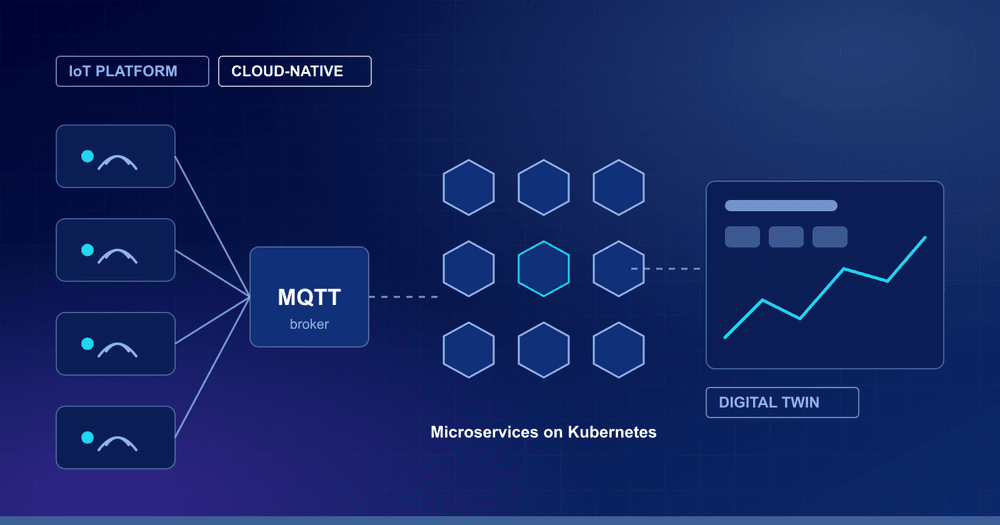
Modern IoT platforms live at the intersection of hardware, networks, and cloud software. To scale from a pilot to thousands of devices—without breaking reliability, security, or cost—you need a cloud-native approach from day one. Below are eight battle-tested practices we use on industrial IoT projects (energy-meters, OEE, LoRa sensors, RabbitMQ → MongoDB pipelines, etc.).
1) Architect for Reliability & Resilience (Fail-safe by default)
- Event-driven core: Ingest with MQTT/AMQP → stream to workers; avoid synchronous chains.
- Idempotent consumers: Deduplicate by (deviceId, timestamp, seqNo) to handle retries.
- Backpressure & DLQ: Use max in-flight, exponential backoff, and dead-letter queues for poison messages.
- Outage tolerance: Buffer at the edge; store-and-forward when WAN is down.
- Exactly-once semantics (practical): Aim for at-least-once + idempotency. Document what is “safe to replay.”
Quick win: Define a standard message header: msgId, deviceId, seqNo, producedAt, schemaVersion.
2) Security by Design (Zero-Trust for Devices & Cloud)
- Strong device identity: Per-device X.509 or pre-shared keys; never reuse creds.
- Mutual TLS & TLS 1.2+: Encrypt in transit end-to-end (device→gateway→broker→API).
- Least-privilege IAM: Separate roles for ingest, processing, and analytics; short-lived tokens.
- Secure firmware & SBOM: Signed OTA images; keep a software bill of materials for each release.
- Secrets hygiene: Vault/SM for keys; never ship secrets in firmware or Docker images.
- Data privacy & tenancy: Enforce tenant scoping at topic, database, and dashboard levels.
Quick win: Rotate certificates automatically and alert on certs expiring within 30 days.
3) Cloud-Native Building Blocks (Kubernetes + Event Backbone)
- Containerized microservices: Split ingestion, parsing, rules, storage, and APIs.
- Kubernetes autoscaling: HPA/KEDA scale by CPU and queue depth (MQTT/RabbitMQ/Kafka).
- API gateway & rate-limits: Throttle bursty clients; enforce auth/quotas per tenant.
- Infrastructure as Code: Version your clusters, topics, buckets, and DBs (Terraform/Helm).
Quick win: Use KEDA to scale workers when RabbitMQ queue length > N or MQTT lag increases.
4) Device Management & Digital Twins (Fleet at scale)
- Digital twin model: Normalize per-device state (last seen, firmware, config, alarms).
- Command/control safely: Use request/ack topics with timeouts; never “fire-and-forget”.
- OTA rollout waves: 1% → 10% → 100% with automatic rollback on failure/latency thresholds.
- Golden config: Versioned configs with drift detection; push deltas, not full blobs.
Quick win: Add a “heartbeat” topic—devices send health every 60–300s; alert if missed N intervals.
5) Edge-First Processing (Reduce bandwidth; improve latency)
- Protocol translation: RS-485/Modbus → MQTT at gateway; standardize payloads at the edge.
- Pre-aggregation & filtering: Compute min/max/avg/energy deltas locally; transmit exceptions/events.
- Local ML/Rules: Simple anomaly checks at the edge to catch issues even offline.
- Safe buffering: Durable queue or WAL at gateway; replay on reconnect with backoff.
Quick win (energy meters): Publish per-circuit topics like plantA/mainPanel/feeder03/power and summary …/hourly
6) Data Modeling, Storage & Lifecycle (Analytics without pain)
- Schema versioning: Include schemaVersion in every message; keep migration mappers.
- Time-series strategy: Choose the right store (TSDB/columnar). In MongoDB: compound index (deviceId, ts), shard by device or site.
- Retention tiers: Hot (7–30 days), Warm (3–12 months), Cold/archive (S3/Glacier) with TTL/ILM.
- Queryable aggregates: Pre-compute hour/day/week aggregates for UI performance.
- Governance: Tag data with tenant, site, asset, and PII flags; audit every export.
Quick win: Create TTL indexes for raw telemetry (ts+180 days) and keep hourly aggregates for 2–3 years.
7) Observability from Day One (Know when and why things fail)
- Metrics: Devices online, ingest lag, consumer throughput, OTA success, 95/99p latencies.
- Logs: Structured, trace-correlated logs (OpenTelemetry). Mask PII before shipping.
- Traces: End-to-end spans from device→broker→worker→DB→API→UI; sample under load.
- SLOs & alerts: Define budgets (e.g., “>99.5% devices heartbeating hourly”) and alert on burn rates.
Quick win: Dashboard the four golden signals per microservice: latency, traffic, errors, saturation.
8) CI/CD & Safe Releases (Cloud + Firmware)
- Multi-stage pipelines: Lint, unit tests, integration tests against emulated devices, canary in prod.
- Feature flags: Toggle rules and dashboards without redeploys.
- Config-as-data: Roll out rule changes via versioned config, not code.
- Firmware CI: Build reproducible images, sign them, and publish to the OTA service; keep release notes.
- Rollback playbooks: Pre-define rollback triggers for both cloud and edge.
Quick win: Canary 5% of workers with the new parser before full rollout; watch parse errors and DLQ rate.
Reference Pattern (Putting it together)
- 1. Edge/Gateway: Modbus polling → normalize JSON → buffer → MQTT publish.
- 2. Broker/Ingress: MQTT (or RabbitMQ/Kafka) with per-tenant topics/queues + authZ.
- 3. Stream Workers: Parse/validate → enrich (site, panel, meter) → idempotent upsert.
- 4. Storage:Raw telemetry (TTL)
Aggregates (hour/day)
Metadata/digital twins
Object storage for long-term/archive - 5. APIs & UI: Query aggregates for dashboards; on-demand raw drill-downs.
- 6. Ops: Observability stack, OTA service, device registry, IaC
Common Pitfalls to Avoid
- Single giant topic/queue for the whole fleet (no isolation).
- Storing secrets in firmware images or Docker ENV.
- No schema version in payloads.
- Writing directly to the primary database from the HTTP webhook (no buffer/backpressure).
- Skipping OTA staging/rollback strategy.
Checklist (for internal reviews)
- Idempotent consumers and DLQs in place
- Per-device identity with cert rotation
- K8s + HPA/KEDA scaling by queue depth
- Digital twin model defined and populated
- Edge buffering & store-and-forward verified
- Time-series retention & aggregates configured
- OTel metrics/logs/traces + SLOs & alerts
- CI/CD with canary + firmware signing & staged OTA